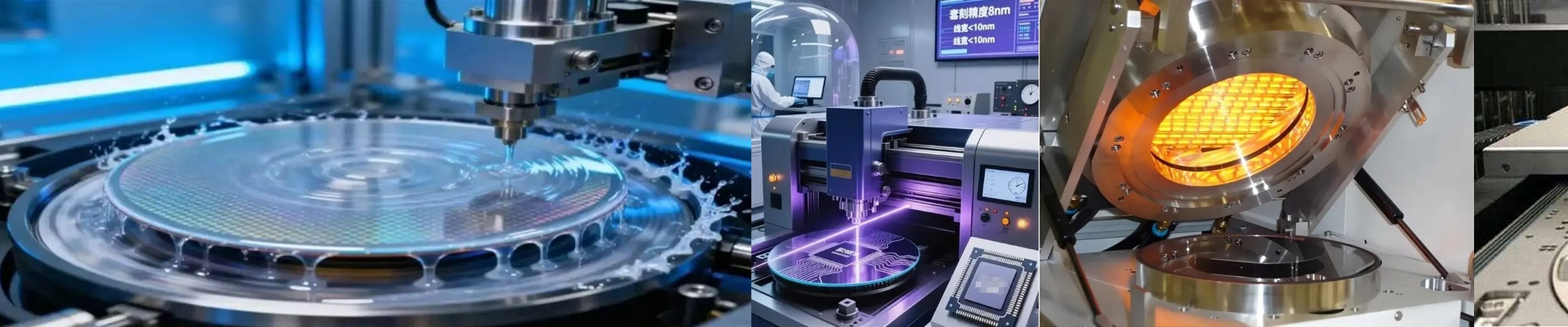
On the 300 mm line, the spin dryer cycles down and the wafer is still wet—water trapped in features, water beading at the edges. Hit it with a conventional hot plate and you risk a slow, uneven ramp that leaves beads behind. Reach for a quick air blow-off and you invite particles. Either way, the next lithography layer is one microcontaminant away from a yield hit. Wafer drying is not a “nice to have.” It’s a controlled moisture removal step with a thermal profile that has to be repeatable, clean, and cost-aware. In photoresist processing, leftover moisture throws off both soft bake and hard bake, and you start to drift on critical dimension control and sidewall profile. The heat source has to hit temperature fast, stay uniform across the wafer, and not add contamination.
What matters, technically
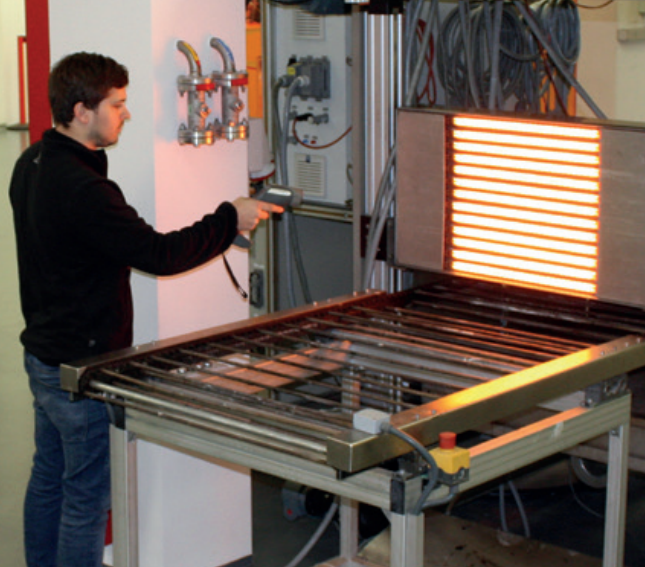
Halogen IR emitters give you short-wave radiation that couples directly into water and into typical wafer substrates, so you can heat rapidly without contact. For wafer drying, we run a halogen filament in a quartz envelope, tuned for quick thermal response and stable output. Pick the wavelength to match the absorption of water films, but avoid over-absorption in the photoresist stack—this keeps unintended thermal stress off the resist. Uniformity across the wafer is the first spec that actually matters. We lay out the emitter array and optics so the incident power gives wafer-level uniformity within ±0.1°C. That’s not a marketing line—it’s the boundary condition that keeps photoresist behavior predictable from lot to lot. Repeatability is specified at ±0.5°C across the operating range, and we verify it with calibrated pyrometers and mapped thermocouples in the production configuration. Cleanroom compatibility is table stakes. The emitter housing is built for Class 1–100 environments, with materials chosen for low outgassing and minimal particle shedding. Surface finishes and seals are rated for standard wet cleans, and the assembly is designed to be cleaned in place—no teardown required. Particle generation, during operation and maintenance, is held to levels consistent with ISO Class 3–4 control, measured as particle count per cubic foot at 0.1 μm and larger. Reliability comes down to uptime and output stability. We qualify halogen emitters for 24/7 operation with planned maintenance windows, not surprise downtime. We track output drift across thousands of thermal cycles, and the driver electronics are spec’d for stable current control so the setpoint holds despite line variation. Units have run 5,000+ hours on pilot lines with under 5% output drop under controlled conditions. Energy efficiency isn’t a perk—it’s a fab reality. Halogen IR dumps energy straight into the target, so you waste less heat in fixtures and surroundings. Compared with convection methods, you hit setpoint faster, which cuts idle time and lowers energy per wafer. That also means a smaller cooling load in the cleanroom and a reduced HVAC penalty.
Why it works in production
Wafer drying in a production fab is constrained by three things: time, contamination, and thermal budget. The wafer has to be dry before the queue backs up. You can’t add particles. And you can’t overheat photoresist or bake in thermal stress patterns that will print as nonuniformities. Halogen IR hits all three constraints with one mechanism: directed radiation. The system heats the water film and the wafer surface directly, without blowing air that can kick particles around. The response is fast, so the thermal cycle is short. The downstream soft bake and hard bake steps are more stable because the incoming wafer condition is consistent—no hidden moisture, no edge beads. In lithography clusters, that consistency tightens critical dimension uniformity and cuts rework. In spin-dry integration, you can place the IR step right after the spin cycle, before the wafer even enters the track bay. The result is a tighter thermal loop, less exposure to ambient, and fewer chances for contamination. **Process repeatability is where this system earns its keep on the line.**Temperature profiles hold within ±0.5°C, and emitter output is stable enough to support statistical process control without constant recalibration. Fewer excursions, fewer engineering lots, and a schedule you can actually trust. Cleanroom compatibility is engineered in, not bolted on. The emitter assembly integrates with SEMI-standard tool interfaces, and the materials meet outgassing limits that protect vacuum and process chambers. Maintenance is straightforward—lamp replacement is toolless in most configurations, and optics cleaning follows standard cleanroom protocols. Particle performance is measured on the tool, not promised on a slide. The gains show up where it counts:
- Cycle time drops because the thermal response is fast.
- Energy per wafer goes down thanks to direct heating.
- Photoresist profile stability improves because pre-bake conditions are consistent.
- Particle-related excursions drop because the process is non-contact and low-shedding.
What you need to know up front
Halogen IR emitters are precise, but they’re not plug-and-play without planning. The quartz envelope is tough, but it’s sensitive to mechanical shock and thermal shock if the system doesn’t enforce controlled ramp rates. Pair the emitter with a controller that manages ramp profiles and provides filament protection at startup. Thermal coupling to the tool matters. Mount the emitter so the radiation path is clean and the heat load is managed. Provide adequate cooling—water or forced air—so adjacent components stay within rated temperatures. If you don’t manage the heat, nearby sensors and polymers will drift. Wavelength and power density have to match the process. If the photoresist stack is sensitive to higher energy densities, tune the emitter power and adjust exposure time accordingly. We can supply application data for common resist stacks, but the final recipe is yours. Run a Design of Experiments to lock down the thermal profile for each film stack. Maintenance is predictable. Halogen lamps have a finite life, and optics will build up thin films over time. Plan for scheduled lamp replacement and periodic optics cleaning. The system is designed for quick access, but you still need to book the window. In our field deployments, routine maintenance runs in minutes, not hours, when it’s planned. And validation is part of the install. The ±0.1°C uniformity and ±0.5°C repeatability only happen with proper mapping, calibrated sensors, and a stable tool environment. We support installation qualification and operational qualification, including thermal mapping across the wafer plane. If your drying step is still a weak point in the lithography flow, chasing faster air or hotter plates won’t fix it. Apply the right energy—precisely, cleanly, and repeatedly. Halogen IR emitters deliver that precision, and they do it inside the constraints of a production cleanroom. We build to the numbers, and we prove them in the fab.